A Lady Vanishes (1 of 5)
This is episode one of The Belshaw Case. A lady vanishes. Shortly after New Year's Eve in 1979, a Canadian couple vacationing in the Swiss ski resort of Cromontana made a sudden impulsive decision, a brief escape to Paris. So on the morning of their first day in the French capital, they boarded the metro together, descending into the crowded underground on what should have been an ordinary day. At one station they parted ways, each with their own plans for the morning, but agreeing to reunite a few hours later at a restaurant in the city center for lunch.
Narrator:The husband arrived on time his wife did not. As the afternoon stretched on and turned into evening, unease replaced the husband's impatience. When she still had not appeared by nightfall, he reported her missing to the French authorities. The disappearance seemed inexplicable. No note, no witness, no reported accident, no obvious reason for her to vanish in the middle of a bustling city.
Narrator:After initial inquiries, the police informed the husband that there was no need for him to remain in Paris while they conducted their search. Reluctantly, he returned to Cromontana a few days later. Weeks turned into months, and three months passed without any trace of the missing woman until a grim discovery was made. A heavily decomposed body of a middle aged woman surfaced not in Paris but in a remote area barely 100 kilometers from the Swiss resort where the couple had been staying. What followed would erupt into one of the most infamous murder cases in modern Swiss criminal history.
Narrator:The investigation sparked an unprecedented wave of fascination and outrage, seized Swiss and international tabloid headlines, and sharply divided public opinion. At the center of the storm a single figure, the husband. As suspicion rapidly closed in on him, a compelling narrative began to harden, driven in no small part by his own actions, culminating in a trial and a verdict scarcely less sensational than the disappearance itself and destined to be argued over for decades to come. Now let's start with the introduction of the main characters, mister and missus Belshaw. Cyril Shirley Belshaw was born on the 12/03/1921 in Waddington, a village approximately 50 kilometers west of Christchurch, New Zealand.
Narrator:From 1940 to 1942, Cyril attended Oakland University earning his MA at Victoria College. Before completing his PhD in social anthropology at the London School of Economics, he worked as a colonial administrator and economist in the South Pacific. Following the war, he resumed his academic pursuits, studying first at the University of New Zealand and later at the London School of Economics, where he earned his doctorate in social anthropology in 1949. Cyril began his career as a research fellow at the Australian National University. At that time, married with two children, the young family relocated to New Guinea where he devoted himself to extensive fieldwork that would form the foundation of his later writings.
Narrator:In 1953, Cyril was appointed to the Department of Anthropology and Sociology at the University of British Columbia, UBC, marking the beginning of a long and successful career. He became head of the department in 1959, a role he held until his retirement in 1974. Known for his unrelenting curiosity, Cyril was a prolific thinker, teacher and writer. His extensive publications spanned academic studies as well as philosophical and political analysis, earning him international acclaim. Cyril also held influential positions in the global academic community.
Narrator:He served on the UN Bureau of Social Affairs and the International Social Scientific Council, was President of the International Union of Anthropological and Ethnological Sciences and editor of the current Anthropology Journal. Additionally, he was recognized as an honorary life member at the Royal Anthropological Institute and a fellow of the Royal Society of Canada, among other prestigious honors. Cyril Bellshaw was universally acknowledged as a remarkably intelligent, capable, and highly respected anthropologist. As a teacher, however, he did not command the same level of admiration. Many of his students found him less inspiring, describing his lectures as dry and his demeanor as demanding, and at times even unsympathetic.
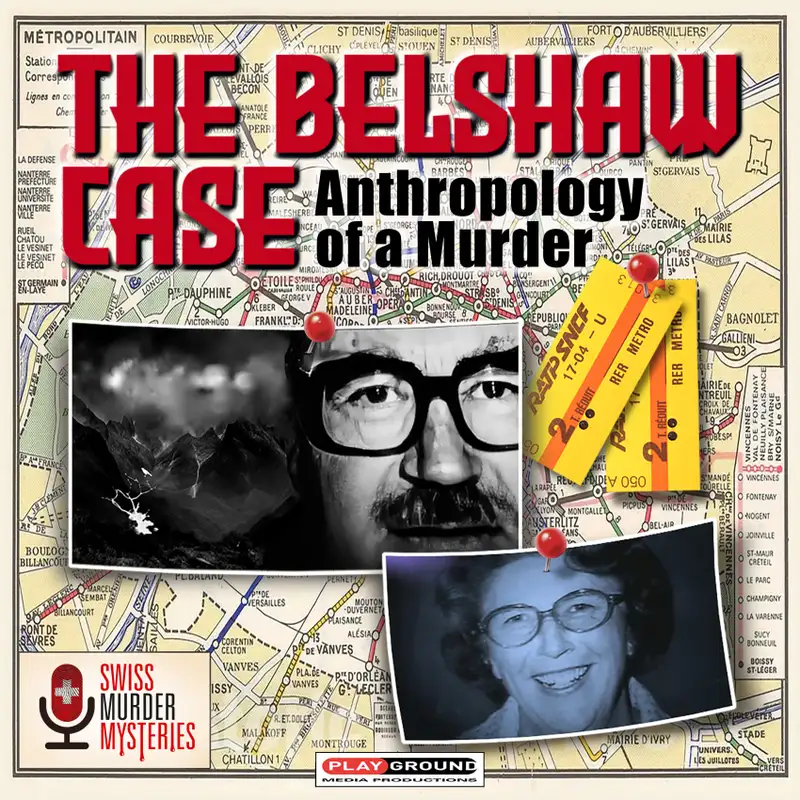
Narrator:He struggled to convey his passion for anthropology in a way that engaged his students. Whether he was aware of this is unclear. All that said, Cyril undeniably fit the image of the professor. He excluded calmness, rationality, intelligence and self control, occasionally displaying unexpected charm when it suited him. And if a child were asked to draw a professor, the result might closely resemble Cyril Belshaw, a kind looking but somewhat diminutive man, slightly overweight, with a fair complexion, thick dark hair, bushy eyebrows behind solid framed glasses, and sporting a distinctive moustache.
Narrator:Beyond his professional persona, Cyril was a devoted husband and a generous father. Despite his deep dedication to his work, he instilled in his children Diana and Adrian values of diversity, adventure respect, kindness, and a profound appreciation for life. He took pleasure in good food, travel, politics, gardening, music, and was an enthusiastic tennis player. Throughout his life, Cyril was supported by his devoted wife, Betty. Betty Joyce Wiedemann was born in Hamilton in the same year as Cyril.
Narrator:The couple met at the age of 21 at the Social Committee of the Students Association. They fell in love and married in 1943. Despite the challenges of the Second World War, their early years together were relatively tranquil and uncomplicated. At the time, Cyril was working as district officer and deputy commissioner for the British Solomon Islands. Following the end of the war in 1945, the couple returned to New Zealand.
Narrator:Two years later in 1947, they moved to London where Cyril pursued and completed his doctorate in social anthropology. Betty played the role of a steadfast and supportive partner during this period. In 1949, their first child, Diana, was born, and four years later, after the family had relocated to Vancouver, Canada, their son Adrian. During this time Cyril traveled extensively, leaving Betty to manage the household and take care of the two young children. In 1958, the family embarked on an extended year long stay in the South Pacific.
Narrator:Betty and the children, then aged five and nine, accompanied Cyril to the Fiji Islands. Adapting to an unfamiliar environment with its challenges required great resilience from Betty. And despite these difficulties, she navigated the experience with determination and grace. Cyril deeply appreciated Betty's contributions to the family. In his 1964 book Under the Ivy Tree, he paid tribute to her enduring support and sacrifices.
Narrator:Betty shared many qualities with Cyril. Both were reliable, organised, ambitious, hard working, and meticulous in their attention to detail. However, unlike Cyril, Betty could occasionally be inflexible and close minded. Despite this, she was undoubtedly kind hearted, whether in her later role as a professional teacher or during her early years dedicated to raising their children and supporting her husband. And those who knew her well described her as gracious, generous, warm, and sensitive in her personal relationships.
Narrator:She was deeply principled, somewhat dependent, and exceptionally faithful to her husband, demonstrating remarkable ease and understanding during Cyril's extended professional absences. In 1966, with her children requiring less attention, Betty joined the English department at UBC. This role further cemented the couple's prominence within the UBC community. The Bellshores lived in a spacious well located home on the University Endowment lands West Of Vancouver and East Of Point Grey Campus. Originally reserved for development that never materialized, the area had become one of Vancouver's most desirable and expensive neighborhoods.
Narrator:Like Cyril, Betty had a stout build and maintained a neat, well groomed appearance with reddish hair that later turned gray. Always impeccably dressed, she often wore tailored two piece suits with a matching vest and skirt paired with oval rimmed glasses. If Cyril personified the archetypal professor, Betty's demeanor and appearance were quintessentially those of an English teacher, a role she embraced once her children reached adulthood. She carried out her duties as the professor's wife with grace and poise, hosting parties and dinners with apparent ease and control, always with a touch of colonial formality. Betty, however, revealed other facets of her personality, especially to those within her inner circle.
Narrator:These traits sometimes surfaced in trivial ways. She was prone to unexplained mood swings, had a tendency to make mountains out of molehills, and exhibited occasional snobbery, and she could easily lose her temper over seemingly minor matters. Was Betty happy? According to her children, yes she was. In 1978, they both agreed to take a break from their professional engagements at UBC.
Narrator:It was the first time in many years that Cyril and Betty would have time for themselves. Cyril planned to work on a comparative study of the Swiss and Canadian constitutions, while Betty, temporarily free from her responsibilities as a senior instructor of English, eagerly anticipated delving into her research and writing on Catherine Mansfield, the celebrated New Zealand born author whose work, though not character, Betty deeply admired. So it is no surprise that for at least some time the couple planned to rent an apartment in Kraumontana, Switzerland. A setting that seemed ideal for both of them and was of particular interest to Betty, as Catherine Mansfield had spent some time there as well. For those unfamiliar, Catherine Mansfield was a pivotal figure in the modernist movement.
Narrator:Her works celebrated worldwide and translated into 25 languages. Mansfield herself had spent time in Cromontana in June 1921 seeking fresh air treatment for her tuberculosis. She stayed at the Chalet Des Sappes where she entered a remarkably productive period knowing her time was limited. Stories such as At the Bay, The Doll's House, The Garden Party, and A Cup of Tea were all written during her stay there. In January 1922, she traveled to Paris for an experimental and costly X-ray treatment, which proved ineffective.
Narrator:She returned to Crown Montana in June, completed her final story, The Cannery, and wrote her will at the local hotel on August 14. Just months later on 01/09/1923, she passed away after climbing a flight of stairs in Fontainebleau, France. Betti's thesis, however, was set to delve far beyond this particular chapter of Catherine Mansfield's life and work. Cras Montana, situated in the heart of the Swiss Alps in the French speaking Canton of Vallee, is a fusion of the villages of Cras and Montana. Its proximity to Geneva Airport makes it highly accessible.
Narrator:Alongside renowned ski destinations such as Seymouritz, Gstaad or Zermatt, Kra Montana undoubtedly ranks among Switzerland's top ski resorts. Perched on the plateau above the Rhone Valley at an elevation of about 1,500 meters or 5,000 feet, it offers breathtaking panoramic views of the Alps. The resort boasts 140 kilometers or 87 miles of ski slopes, including the Plein Morts Glacier kept by the Pointe De La Plein Morts at 2,927 meters or almost 10,000 feet. The village combines the charm of a modern holiday destination with the tranquility of a natural alpine landscape. It offers extensive shopping opportunities, a renowned cultural and congress center, a variety of accommodations, and for golf enthusiasts hosts the annual Omega European Master Tournament.
Narrator:As I record this episode in the early days of the New Year, the village has made international headlines. On 01/01/2026, around 01:30AM, during New Year celebrations, a fire erupted at a local bar. Tragically, forty people lost their lives, and one hundred and sixteen others were injured, most of them between the ages of 16 and 24. This devastating incident is a tragedy not only for the village but for all of Switzerland, resulting in a day of mourning marked by church bells ringing across the country and flags being flown at half mast. Eager to make the most of their shared year off, Cyril left Vancouver for England early in the summer of nineteen seventy eight.
Narrator:He arrived ahead of Betty to meet their friends Rosemary and Raymond Firth, before they departed on a trip to New Zealand. During their absence Cyril and Betty were invited to stay at the Firth's home in Hampstead, North Of London. For the latter part of the year, the Bellshows planned to settle in Cromontana, a destination they had visited before and grown to love. After a few days in England, Cyril went on to Cromontana to secure accommodations. He checked in at Les Michel Belles, where he and Betty had stayed before, only to find out that the long term rental was well beyond their budget.
Narrator:But something about his scouting visit was rather peculiar. While searching for an apartment in Cromontana, Cyril wasn't alone but in the presence of a woman. And that woman was not Betty, but a certain Mrs. Harris, a student of Cyril's from Vancouver. Cyril and Mrs.
Narrator:Harris met with local estate agent, a certain Mrs. Viest, the next day and looked at the Jolie Lock apartment situated below a steep incline from the village center just above the lake. The chalet like building had six apartments. The parking was located above the house, reached by a somewhat hazardous walkway bridge leading to the main door. Quite happy with the discovery, Cyril told Mrs.
Narrator:Beast that he was very much interested in renting the apartment, but that he would prefer to call his wife in London to get her approval as well. Not surprisingly, this remark left a somewhat puzzling and lasting impression on Mrs. Weierst, who at the time assumed that Mrs. Harris and Cyril were rather intimate. Having finally received Betty's approval and security accommodation, Cyril, a car enthusiast, travelled to Rotterdam in The Netherlands via Paris to pick up his beloved car, a Citroen Maserati he had shipped over from Canada.
Narrator:Whether Mrs. Harris was still with him in Rotterdam is not confirmed, but she certainly was not when Cyril reunited with his wife at their temporary home in Hampstead near London a few days later. In the coming weeks, Betty wrapped herself up in her work and spent many days from early morning to eight afternoon at the British Library in London, while Cyril took care of the shopping and cooking, read a lot, and tended to the garden. Towards the end of their stay, while spending a couple of nights at the first cottage in Devon, Betty briefly fell ill. In 2013, Cyril Belshaw granted a significant interview to RTS, Radio Television Swiss for their documentary program.
Narrator:These interviews are notable because Belshaw, who was 91 years old at the time, agreed to speak publicly about the case and its impact on his life for the very first time. Here then is his recollection.
Belshaw:Betty was often quite uptight, know, I mean, that's normal. But in England, she had had a bit of a blackout. And it was just before we were leaving for Switzerland.
Narrator:An apparent minor incident at the time, it became of importance much later. But anyway, towards the end of November, they packed their car, boarded the ferry in Dover, and drove across France towards Switzerland, eventually arriving in Cromontana. Shortly after settling in, Cyril took a brief trip to New Delhi to attend a congress organized by the International Union of Anthropological and Ethnological Sciences. But a few days before Christmas, just in time to welcome their son Adrian and his girlfriend, who were visiting from Spain during a holiday, he arrived back in Cromontana. According to Cyril, they had a wonderful Christmas together, enjoying peaceful walks around the frozen winter lake, exploring the decorated shops, and savoring Betty's sumptuous Christmas feast.
Narrator:And when Christmas gave way to New Year, everything seemed perfect. However, change was on the horizon. Adrian and his girlfriend's departure left Betty in a profoundly sad and depressive state. The joyful and vibrant family days had vanished in an instant. Perhaps in an effort to lift petty spirits, Cyrille suggested a brief visit to Paris.
Narrator:On 01/07/1979, Cyril Belshaw picked up the phone and booked a double room at the Novotel Bagnoli in Paris for January 14. The hotel, a massive square building with over 600 rooms and more than 30 conference facilities, was a clean, comfortable, yet distinctly impersonal four star business establishment. It was hardly the sort of place a husband would choose for a romantic Paris getaway with his wife. Yet despite its obvious lack of charm, the hotel also had notable advantages. It was conveniently located on the East Side Of Paris at Port Bagnoli, offered spacious rooms with large desks, in house parking, a feature that was important for cereal, and it was close to the metro station, providing easy access to the city centre.
Narrator:In less than fifteen minutes, they could reach the Bibliotheque Nationale where Betty planned to delve into her research on Catherine Mansfield. Late on the morning of Saturday, 01/13/1979, Cyril and Betty loaded up the Citroen Maserati again, preparing for the long drive to Paris despite severe winter weather conditions that could cause significant disruptions to road travel in both Switzerland and France. Interestingly enough, the car was at the workshop until the previous day. Probably due to the cold weather, its battery had died and needed replacement or recharging. Now let me take this opportunity to offer you a few insights about the particular car Cyrill drove at the time.
Narrator:He had purchased the Citroen Maserati or Citroen SM in 1972 while in Europe and later imported it to Canada. The car was so cherished that when he and Betty planned their European sabbatical six years later, Serial arranged to have it shipped back from Vancouver to Europe, intending to refurbish its bodywork. However, the high costs ultimately prevented this plan. The Citroen SM was a rare, high performance car produced by the French manufacturer Citroen between 1970 and 1975, with only 12,920 units made. Its distinctive aerodynamic avant garde design and rarity turned heads wherever it went, even more so with Canadian license plates.
Narrator:A picture of the car can be found on our website. The point is, if someone spotted such a car parked by the roadside or in an unusual location, it would undoubtedly leave a lasting impression. This is worth keeping in mind as we follow Cyril and Betty's travels across Europe. But now let us return to that Saturday when the Belshores finally got their car running. So they left Montana late in the morning and navigated the winding mountain road into the wide Rhone Valley heading west towards Lake Geneva.
Narrator:According to Cyrille's account, after crossing the border into France, they went south, probably towards Ansee, intending to join the North South Freeway to Paris later. This was a significant diversion and worsening road conditions, along with constructions caused additional delays. Driving on slushy, snow covered roads was anything but pleasant. Conditions only improved slightly once they reached the autoroute. By nightfall, they opted to stop for the night at the hotel near Bone, just off the highway.
Narrator:The next day, January 14, they finally arrived in Paris, checked into the Novotel Bagnoli in the late afternoon. When Cyril filled out the registration form, he wrote his full name and somewhat unusually added Aunt Betty. Think about this for a moment. He did not write Mr. And Mrs.
Narrator:Belshaw or Cyril and Betty Belshaw, but specifically Cyril Belshaw and Betty. This might lead to the assumption that he first only registered himself and then, for whatever reason, it dawned on him that he should also include his wife Betty. Cyril later explained that Betty had jokingly pointed out how unfair it was that only the man's name was traditionally recorded, hence he added hers too. Exhausted from the journey, they had dinner in their room and went to bed early. Now on the next faithful day, Monday, January 15, the couple had breakfast in their room around nine a.
Narrator:M. By ten a. M. They left the hotel with Betty carrying her usual satchel. Inside were all the necessary documents, letters of introduction and credentials required to gain access to the Bibliotheque Nationale where she planned to review relevant material for her research on Catherine Mansfield.
Narrator:Personal registration was necessary because many of the library's resources, particularly rare books, manuscripts, etc, were not available to the general public. Registration provided access to those invaluable and often fragile items as well to specific reading rooms that house specialised collections. So after leaving the hotel they purchased two metro tickets at Port Bagnoli and boarded line number three heading towards the city centre. About twenty five minutes or 10 stops later, Betty got off at Burghs, the station closest to the Bibliotheque Nationale, just a five minute walk away. Cyril, however, stayed on the train, most likely disembarking two stops further at Opera.
Narrator:They had planned to meet for lunch at 1PM at Gallerie Lafayette, an upscale department store, its flagship location about a fifteen minute walk from the Bibliotheque Nationale where Betty was expected to spend the morning. With two and a half hours to kill before their agreed meeting, Cyril strolled about and did some window shopping. By 1PM, he arrived at Gallery Lafayette. He waited a few minutes in front of the cafe, then went inside, sat at the table, and ordered a drink. When it was two p.
Narrator:M. And Betty still hadn't arrived, he started to feel uneasy. Betty was usually punctual and knew her way around Paris. So he paid the bill and headed to the Bibliotheque Nationale, thinking there must have been some misunderstanding, either time or location wise. When he reached the main entrance, he was met with a long line of applicants.
Narrator:Growing more concerned, he pushed through to the registration desk. The lady checked the morning's records, but then told Cyril that she had no record of Betty's application. Without one, Betty couldn't have possibly entered the library. Here is Cyril's account of the incident given in an interview to Television Swiss Murder in 2013.
Belshaw:At first, I thought, well, she'd forgotten. But it was time went on, time went on, time went on. And so I said, something has happened. I don't know what, but she's she's disappeared. And it was getting later, late in the afternoon by now.
Belshaw:Something was wrong.
Narrator:Now genuinely worried, Cyril hurried back to the Novotel Vignolet, checked their room, spoke with the concierge and the receptionist. Finally, he called the front desk and reported Betty missing, asking what could be done. Receiving little help from the hotel staff, he rang the Canadian embassy. They informed him that a missing person case was the responsibility of the consulate, which was unfortunately closed by that time. However, they advised him to visit the consulate in person first thing the next morning.
Narrator:Cyril then phoned his children Adrian and Diana, both back in Canada and at the time 30 and 20 years of age. Alarmed by the unsettling news, both agreed to fly to Europe as soon as possible. As Cyril went to bed that night, sleep eluded him. A whirlwind of questions and images went through his mind, refusing him to rest. He lay on his back staring at the ceiling while Betty's face flickered in his thoughts, haunting him with an unsettling memory.
Narrator:And as he drifted into a dreamlike haze, Betty's image began to slowly dissolve, not only fading from his dreams, but unknowingly or not, vanishing entirely from his life. Early the next morning, Cyril rushed to the Canadian embassy. Due to his VIP status, the consul received him personally and told him to visit the police station in Banyolay to file an official missing persons report complete with a description of Betty. The consul offered to call ahead to inform the police of Cyril's arrival. Meanwhile, the embassy would contact all major hospitals in Paris.
Narrator:Cyril was also asked to provide a recent photograph of Petty upon his return to Crown Montana. At Banhollet police station, Cyril was shown to a small room furnished with only a desk, two chairs, and a typewriter. He answered all their questions, offering a detailed description of Betty and what she had been wearing the previous day. His description was so precise that it even included the brand of Betty's underwear, a detail Cyril later explained by mentioning that he always bought this brand for Betty when on a trip in Europe. Why he was certain she wore exactly that particular brand that particular day remains a mystery.
Narrator:The consul urged Cyril to remain calm and suggested that the best course of action would be for him to return to Cromontana. There was still a slim chance that Betty, for reasons unknown, had returned to Switzerland on her own. Cyril spent another day in Paris making phone calls and already writing letters to friends to inform them of his wife's disappearance. Finally, on January 18, a distraught serial packed his and Betty's suitcase, loaded them into his Citro ASM, and left Paris. He felt confident that he had done everything possible to find her.
Narrator:However, it did at no point in time occur to him to call the concierge at their apartment in Crown Montana, nor did he see the need to inform the Swiss police. The drive to Crown Montana was an eight or nine hour journey, including at least one stop for fuel, a sandwich, or a quick coffee. But when Cyril reached the Rhone Valley just 70 kilometers or 45 miles from his final destination, he turned off the highway at a village called Bay and spent the night in a motel. While this might seem a bit odd, Cyril later explained that he wasn't in the right state of mind to face the steep and winding mountain road to Crown Montana in the dark and under poor road conditions. So finally on 01/19/1979, Cyril arrived back in Cromontana at their Joli Lac apartment.
Narrator:Snow greeted him, but no Betty. His daughter Diana, an actress performing in Calgary, managed to find a stand in and flew to Switzerland where Cyril picked her up at Geneva Airport on January 21. While stroking about in the village, Cyril and Diana run into Sammy Friedman, the Secretary General of the Social Science Council, and his lady friend. Cyril and Diana invited them for tea at the Jolie Lock apartment and Cyril informed Sammy about the recent tragedy. Ten days later on January 31, his son Adrian arrived.
Narrator:His children's presence was a comfort to Cyril. Together they spent contemplating every possible scenario that might explain Betty's disappearance, but fell short of a reasonable explanation. One day Diana opened Betty's suitcase and washed her clothes. When his children left and Cyril was alone again, he slipped into a deep depression. To regain some sense of normalcy, he decided to resume his professional responsibilities, which also asked attending a meeting of the Association of Social Anthropologists of the Commonwealth in York, England.
Narrator:During a brief visit with the Firths, who had meanwhile returned from New Zealand, Cyril received a phone call from the Paris police. His heart leapt with hope, but it was short lived. The commisserie de police had no new information about Betty, but requested Cyril's presence to provide further details. Determined, Cyril drove to Paris in his situa Maserati, enduring two flat tires along the way to answer their questions. It was a puzzle to him why they requested his physical presence for those.
Narrator:Afterwards, seeking distraction, Cyril drove from Paris to Basel to attend the famous carnival. Though he found some joyment, the positive effects were fleeting. Meanwhile, the news about Betty's disappearance had also reached Canada, and the press were anxious to interview the husband. Understandably Cyril was not especially keen on returning home, yet slowly his time in Europe started to wind down. He returned to Cromontana to clear out the apartment, settle the account, and prepare for his return to Vancouver.
Narrator:Courses back home were beckoning. Here again is Cyril's recollection.
Belshaw:I was increasingly desperate. I spent quite a bit of time crying. As the days went on it got worse and worse and worse and worse. As time went on, it became clearer that wasn't clear, but it became more likely that Betty was not alive.
Narrator:But then on April 13, Stereal received an unexpected call from Swiss police investigators requesting a meeting at his apartment. The voice at the other end was calm yet deliberate, leaving Cyril with a sense of unease. That afternoon two senior officers, Mr. Reichen and Mr. Ginyar, from the Sierra Valley Police arrived.
Narrator:They settled on the patio, the chill of the mountain air adding to the tension as Mr. Reichen spoke. His tone was measured, almost casual, as he explained that they were aware of the circumstances surrounding Betty's disappearance. Cyril listened intently. There was something about Reichen's demeanor, something off.
Narrator:Every now and then Reichen's eyes scanned the apartment and its surroundings, his gaze lingering on seemingly unimportant details. Then Reichen asked a question that pierced the column. Mister Belshaw, would it be possible for you to provide us with the name of your wife's dentist so we could ask him for her dental records? His voice almost too composed. Cyril stiffened.
Narrator:Her dental records, he repeated, is unease growing. Reichen nodded. Cyril hesitated, though he couldn't suppress the obvious question. Why? Have you found have you found her body?
Narrator:Reichen's reply came quickly. No, not really. The officer's tone was firm, his expression practiced, but there was a fleeting moment, a flicker in his eyes, that Cyrille couldn't ignore. It was though Reichen's response concealed a deeper truth, something unspoken, sinister. Finally it was agreed that Cyril would organize the dental records directly and then submit them to the police personally.
Narrator:Moments later, Reichen and Guinea departed, their footsteps crunching on the snow as the door clicked shut behind them. Cyril stood alone, the silence in the apartment now oppressive. He stared out at the distant mountains. Something wasn't right. Reichen's question lingered in his mind like a shadow.
Narrator:The request for dental records was no formality. And the longer serial replayed the interaction in his head, one thing became chillingly clear. Inspector Aeschimann did not tell the truth. Stay tuned to find out if Cyril Bellshaw was right and tune into The Alpine Corps, episode two of the Bellshaw case, another mysterious and puzzling criminal case as part of the Swiss Murder Mysteries podcast. Researched, written and hosted by me Rudolph Isler.
Narrator:Please do visit our website at swissmurdermysteries.com to get familiar with geographical details and for additional information, including maps and photographs, and even details on how to support the creator of this podcast if you think he deserves it. Available on Apple Podcast or any platform of your preference.
Creators and Guests